Case Study | AVD Design & Deployment
From Citrix to Azure Virtual Desktop for a U.S. Legal Organization
We designed and deployed an AVD environment for 1000 people organization, aligned with its cloud strategy, operational requirements and business continuity objectives.

Industry
Legal Services
Location
United States
Organization
1000 People
Background
The organization operated an established Citrix environment supporting approximately 1,000 people. As its next licensing renewal approached, the associated costs prompted a wider review of its virtual desktop strategy.
At the same time, the organization was pursuing a broader cloud strategy centered on Microsoft Azure. Moving to Azure Virtual Desktop presented an opportunity to align desktop infrastructure with this direction while reconsidering how the environment would be supported and managed over time.
Business continuity was another important consideration. The organization wanted regional resilience and recovery to be considered as part of the new platform architecture.
The Challenge
Moving from an established Citrix environment to Azure Virtual Desktop required more than reproducing the existing desktop configuration in the cloud.
The new platform needed to accommodate different user groups and application requirements, including both pooled and personal desktops. It also needed to provide access to legal applications and business systems while addressing identity, authentication, profile management, and security.
The architecture also had to support the organization’s wider Azure strategy, operational support needs, and regional recovery requirements. The challenge was to bring these elements together in a coherent design that could meet user needs and remain manageable to operate.
Our Approach
The Solution
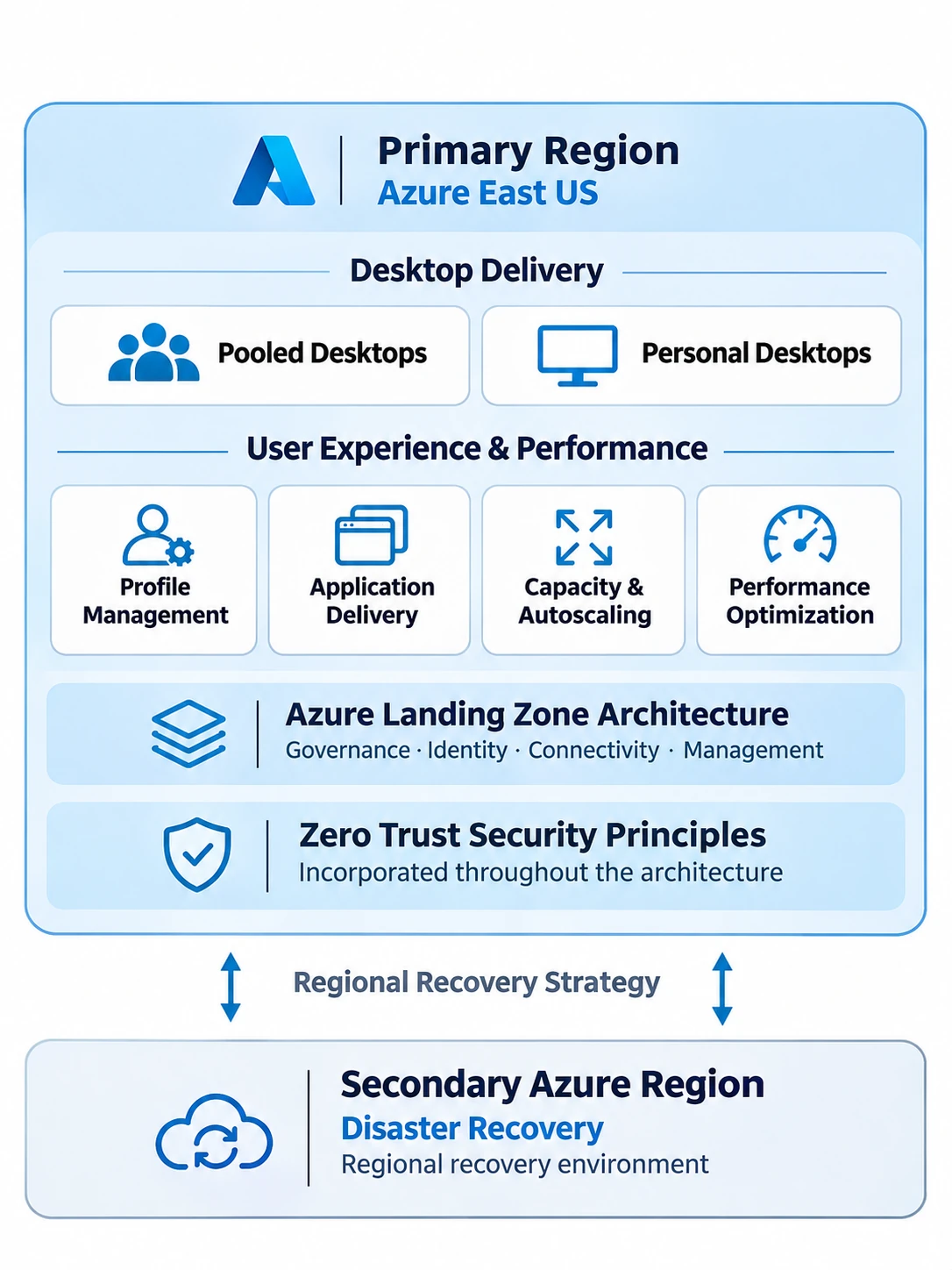
The new environment combined pooled and personal desktop delivery models to support the organization’s different user groups and application requirements.
The primary deployment was established in Azure East US, with a secondary Azure region incorporated into the disaster recovery strategy. This regional design formed part of the wider business continuity approach.
The architecture followed Azure landing zone best practices, with Zero Trust security principles incorporated throughout. The desktop design focused on delivering a high-performance, responsive user experience, addressing profile management, application delivery, session host capacity planning, and autoscaling to align resources with changing demand. Performance optimization was considered across the environment to support application responsiveness and a consistent user experience.