
Case Study | AVD MANAGED SERVICES
Keeping Azure Virtual Desktop Responsive Through Tax Season
An Azure Virtual Desktop environment designed and deployed around the firm’s accounting and tax applications, with ongoing management to maintain performance, accommodate seasonal demand and optimize Azure costs.

Industry
Accounting
Location
United Kingdom
Organization
100 People
Background
An accounting firm needed a new virtual desktop environment to support approximately 100 users accessing its core accounting, bookkeeping and tax applications.
Workloads varied throughout the year, with concurrent user demand increasing during tax season as teams handled higher volumes of client work. The firm needed a platform that could support these fluctuations while providing reliable access to its business-critical applications.
The engagement covered the design and deployment of a new Azure Virtual Desktop environment, followed by ongoing managed services to support its day-to-day operation and evolving business requirements.
The Challenge
The firm needed to balance application performance, desktop capacity and infrastructure costs as user demand changed throughout the year.
During tax season, higher concurrent usage placed additional demands on session-host resources. Core accounting and tax applications needed to remain responsive, with sufficient capacity to accommodate periods of increased activity.
Outside peak periods, however, maintaining infrastructure sized for maximum demand could leave resources underutilized and drive unnecessary Azure expenditure. Application delivery also needed to be suited to a multi-session environment to make effective use of available resources.
The challenge was to accommodate seasonal peaks without compromising the user experience or carrying unnecessary infrastructure capacity throughout the year.
Our Approach
We approached the engagement with a focus on workload-led architecture, followed by continuous operational oversight. The initial design addressed the firm’s anticipated requirements, while ongoing management would be guided by actual usage and performance as the environment operated in production.
The Solution
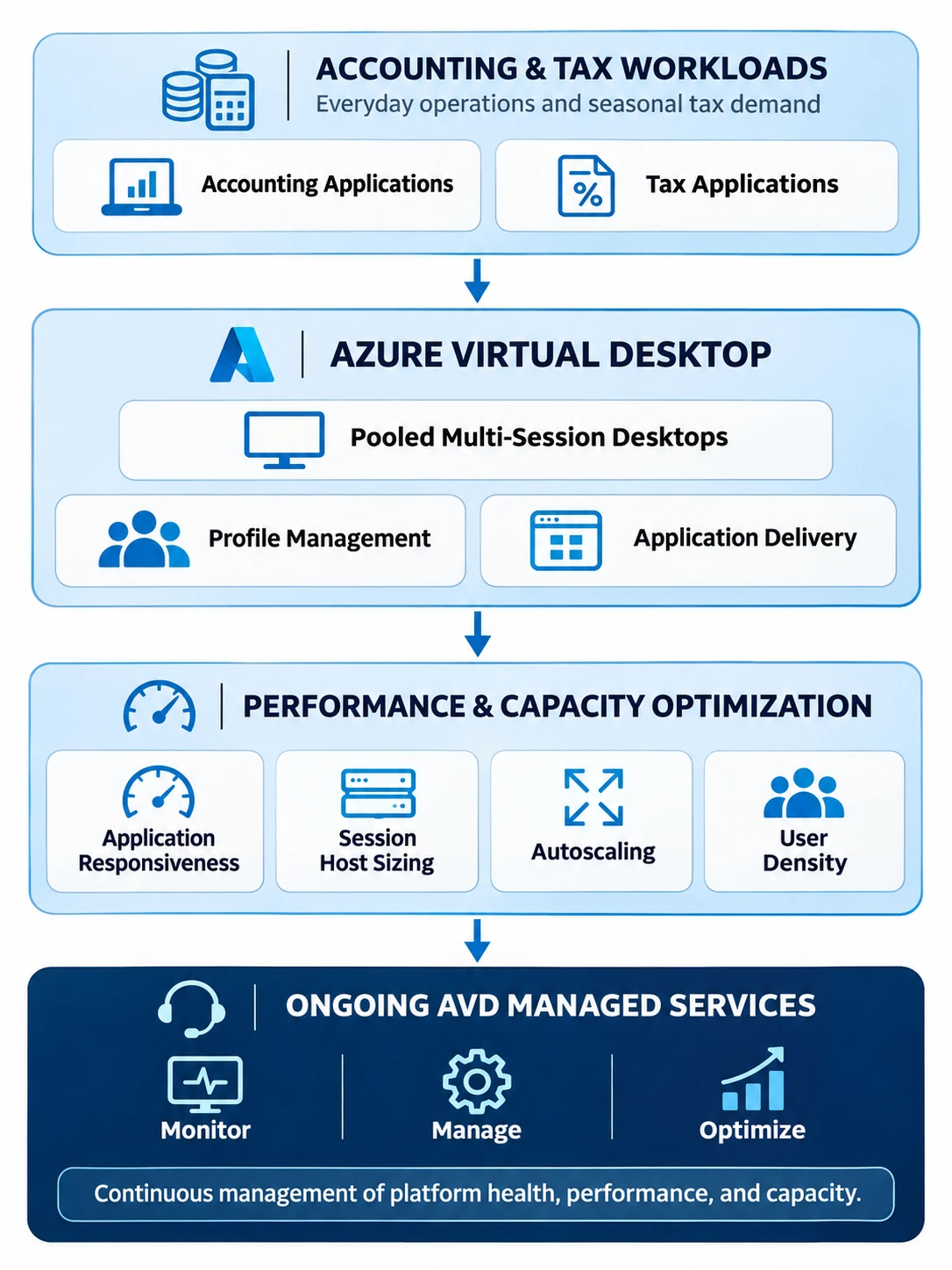
We designed and deployed an Azure Virtual Desktop environment tailored to the firm’s accounting and tax applications.
Session-host configurations and application delivery were optimized for the firm’s anticipated concurrent workloads and multi-session requirements. We also implemented autoscaling and dynamic capacity management to align available resources with changing demand, accommodating higher usage during tax season without maintaining the same infrastructure capacity throughout quieter periods.
Following deployment, ongoing management covered platform health, desktop and application performance, session-host utilization and Azure resource consumption. This provided continued operational oversight and enabled capacity and resource allocation to be adjusted as the firm’s requirements changed.
Results & Business Benefits
Through the initial design and deployment, followed by ongoing management and optimization, the firm achieved improvements in application responsiveness, infrastructure utilization, and its ability to accommodate seasonal workloads.
The key outcomes included: